

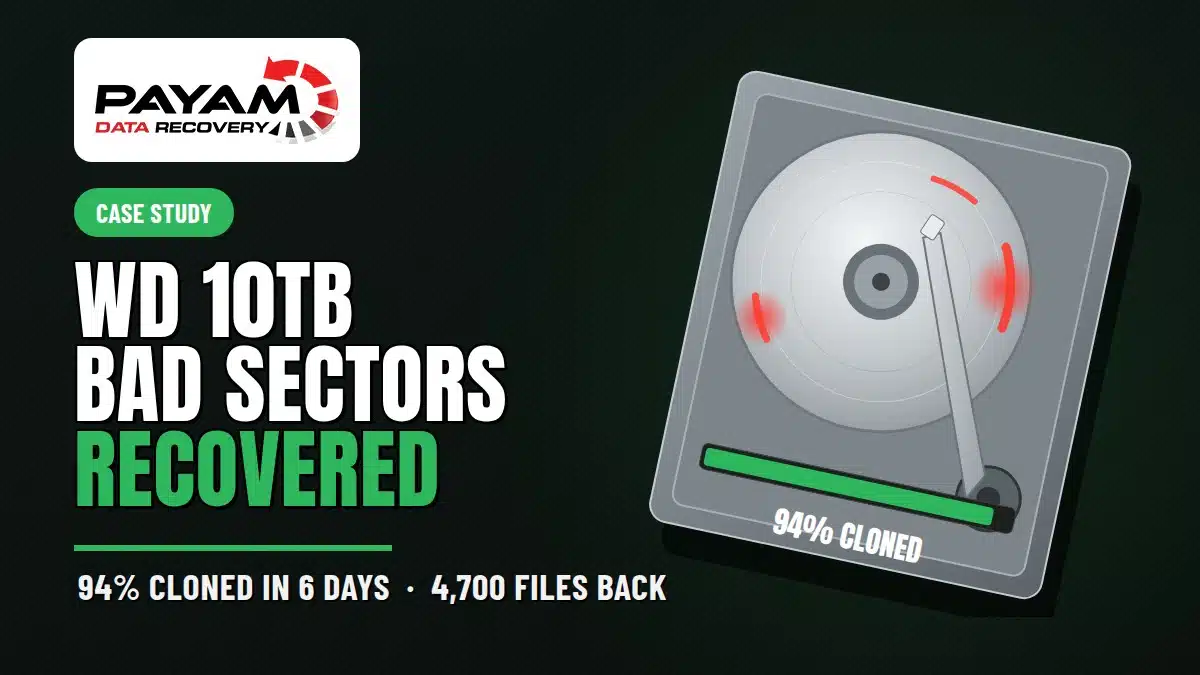
Can a WD 10TB hard drive with bad sectors be recovered when it shows up on the computer but nothing will copy? In this case, yes. Our data recovery engineer cloned it sector by sector for six days, stopped at 94 percent, and about 4TB and 4,700 files came back with only a handful damaged.
Case study summary
Client: A car mechanic’s workshop, Western Australia
Device: Western Digital 10TB SATA hard drive, model WD101EZAZ, pulled from a generic USB enclosure
Problem: The drive showed up on the computer, but nothing would copy off it. Another place had already tried without success
What we found: The drive powered on, was detected and sounded healthy on the PC-3000, but the SMART status was bad, with a large number of bad sectors. The platters had media defects
What we did: A sector by sector clone on the DeepSpar Disk Imager, run unattended for six days and stopped at 94 percent before the heads started to fail. No head replacement. A senior data recovery engineer then opened the clone on a recovery workstation
Result: About 4TB of data, around 4,700 files, with every folder and file name intact. Only a handful of files fell in the unreadable 6 percent, and they were marked in the file list
Turnaround: Six days of imaging, then the files were saved to a new 5TB WD My Passport, a 13 hour job in total
Cost: Confirmed in the free written quote before any work began
Sound familiar?
- Your hard drive shows up on the computer, but copying files fails or never finishes.
- A disk check reports a bad SMART status or bad sectors.
- The drive spins up and sounds normal, with no clicking.
- Someone has already tried to get the files off it and could not.
Same problem? Call 1300 444 800 or request a free assessment.
A 10TB Drive From a Mechanic’s Workshop That Would Not Copy
This WD 10TB bad sectors data recovery case study starts in a car mechanic’s workshop in Western Australia. The workshop used a Western Digital 10TB SATA drive, model WD101EZAZ, inside a generic USB enclosure.
One day the drive still showed up on the computer, but nothing would copy off it. The owner had already tried somewhere else without any success.
Then they watched some of our case study videos. The drive was pulled from its enclosure and posted right across the country to our lab in Sydney.
The Problem: Why Does a Hard Drive Show Up but Files Will Not Copy?
Our data recovery engineer tested the drive on the PC-3000. It powered on. It was detected. It sounded healthy.
The SMART status told a different story. It was bad, with a large number of bad sectors.
That explains the symptom. A drive with bad sectors can answer the computer and show its name and size, so it looks fine at first. But when a copy reaches an area the heads cannot read, the drive retries again and again. The copy stalls or fails, and each retry adds wear to the heads.
A drive in this state does not need to click to be in trouble. Healthy sounds and a bad SMART status together are a common sign of damage on the platter surfaces.
The WD 10TB Bad Sectors Data Recovery Process
Copying files one at a time from a drive like this is the wrong approach. So the drive went onto the DeepSpar Disk Imager for a sector by sector clone.
The imager reads the whole surface into a copy, working around the damaged areas rather than getting stuck on them. It skipped the bad areas and powered the drive off and on again when it stopped responding.
A healthy 10TB drive takes about a day to clone. This one ran unattended for six days.
After six days the heads started to fail, and our data recovery engineer stopped the imager there. By then 94 percent of the drive had been cloned.
Why Stop at 94 Percent Instead of Replacing the Heads?
When heads begin to fail, a head replacement is often the next step. The team looked at this drive closely and judged that the heads were not the real problem.
The platters had media defects. These are unreadable areas on the disk surface itself. New heads would still be reading the same damaged surface, so a head replacement would not fix them.
It would also have added donor part costs for no gain. So instead of more surgery, the job moved on with the 94 percent clone already in hand.
This is a judgement call we make on the evidence from each drive. Sometimes the right answer is more work on the hardware. Here, it was knowing when to stop.
WD 10TB Bad Sectors Case Study: The Results
A senior data recovery engineer took the clone to a recovery workstation. The file system opened straight away.
There was about 4TB of data on it, around 4,700 files. Every folder and every file name was intact.
The files were saved to a new 5TB WD My Passport, a 13 hour job in total. The file list showed that only a handful of files fell inside the unreadable 6 percent.
The customer received an email listing every file, with the damaged ones marked, so there were no surprises about what had come back. They could collect the drive or have it sent back by express post free of charge.
What Should You Do If Your Drive Has Bad Sectors?
If your hard drive is detected but the files will not copy, or a disk check shows bad sectors, leave it unplugged.
Every attempt to copy files makes the heads work over the damaged areas again. Recovery software does the same thing, scanning the whole surface over and over. Heads that are already under strain can fail, and a drive that could have been cloned becomes a much harder job.
Do not open the drive either. Turn it off and get in touch for a free assessment. If you have already tried somewhere else, tell us what was done. It helps us plan the imaging.
Why People Choose Payam Data Recovery
A failed hard drive needs an experienced data recovery engineer, and often a matching donor part. We work on 10 to 15 drives with failed heads every day.
- We are a specialist data recovery lab, not a computer repair shop. We have been recovering data since 1998, from over 300,000 devices.
- The best equipped data recovery lab in Australia: an ISO 5 certified laminar flow cabinet for head replacements, an anti-static lab, microscopes and microsoldering stations for circuit board work, the Ace Lab PC-3000, Atola Insight Forensic and DeepSpar Disk Imager, and over 30,000 donor parts, including around 20,000 donor hard drives. When your drive needs a matching part, it is usually already on our shelf.
- Over 2,000 IT companies and computer shops across Australia send us their customers’ complex cases, and data recovery labs and IT companies in more than 50 countries have sent us their difficult cases over the past ten years.
- Rated 4.9 from more than 2,300 Google reviews.
- About 90% of our jobs are no fix, no fee. The hardest 10% carry an attempt fee.
- See your files before you pay. You tell us which files matter most. Before you pay for the recovery, we’ll send you a list of your recovered files so you can check them. If any of the files you listed are missing, tell us and we’ll search again.
- There is no card surcharge. Pay by Visa, Mastercard, American Express, Afterpay, Zip or bank deposit (EFT).
- Everything is done in our own labs in Australia and never outsourced overseas. Call or visit us, and you can speak with the data recovery engineers who do the work.
We are not the cheapest. We are the best in Australia at this work. We know what to do, how to do it, and we will do our very best for you. Your best chance of getting your data back is with us.
Hard Drive Data Recovery Pricing and Services
Every hard drive case starts with a free assessment and a written quote. We test the drive, then email you the problem we found, how we can help, the cost and the time involved, for your approval before any chargeable work.
A hard drive with bad sectors, like this one, carries no attempt fee. The price of bad sector and similar faults depends on what we find, and current prices are on our hard drive data recovery page. Priority and Emergency service cost more and are faster. Your quote confirms the exact price.
If you need to know sooner, an urgent written quote within 1 to 2 hours is available for a fee. We can supply a destination drive, or you can send your own.
Our hard drive data recovery service covers every brand and size, desktop and portable, including all Western Digital drives. Drives pulled out of a USB enclosure are welcome too. Send the bare drive, without cables or the enclosure.
How Our Process Works for International Customers
International customers are always welcome. The easiest way to reach us from overseas is by email at help@payam.com.au, which works in every time zone. Start with the free quote form. If the indicative pricing suits you, we send job instructions and you post the drive to our main data recovery lab in Rhodes, NSW by a tracked courier. Recovered data comes back on a new drive.
Frequently Asked Questions
My hard drive shows up but the files will not copy. Can the data be recovered?
Often, yes. This WD 10TB drive was detected and sounded healthy, but it had a large number of bad sectors. We cloned it sector by sector for six days and reached 94 percent. About 4TB and 4,700 files came back, with only a handful damaged. Stop copying and have it assessed.
What does a bad SMART status mean on a hard drive?
SMART is the drive’s own health report. A bad status usually means the drive has found many sectors it cannot read reliably. The drive may still spin, sound normal and show up on the computer, but copying files keeps failing. It is a warning to stop using the drive and have it imaged.
Why did the clone take six days instead of one?
A healthy 10TB drive takes about a day to clone. This one had a large number of bad sectors, so the DeepSpar Disk Imager had to skip damaged areas and power the drive off and on when it stopped responding. It ran unattended for six days and reached 94 percent.
Why not replace the heads to read the last 6 percent?
The team judged the heads were not the real problem. The platters had media defects, unreadable areas on the disk surface that new heads cannot fix. Swapping heads would have added donor part costs for no gain, so the 94 percent clone went straight to a recovery workstation instead.
Will I know which files are damaged?
Yes. On this job the customer received an email listing every recovered file, with the damaged ones marked. Only a handful of the 4,700 files fell in the unreadable 6 percent. You see exactly what came back before the drive is collected or sent back by express post.
If you cannot recover my data, is there nothing to pay?
Yes. The assessment and quote are free, and for most faults there is nothing to pay unless we recover your data. See your files before you pay. You tell us which files matter most. Before you pay for the recovery, we’ll send you a list of your recovered files so you can check them. If any of the files you listed are missing, tell us and we’ll search again. The one exception is cleanroom and other high risk work, where part of the quoted price is a non-refundable attempt fee paid upfront so we can begin. That covers the data recovery engineer time and donor parts we commit whatever the outcome. If an attempt fee applies to your job, it will be stated clearly in your quote before you approve anything.
Can I send my drive from Western Australia or overseas?
Yes. This drive was posted across the country from Western Australia, and the recovered files went back free of charge. We work for people all around Australia, and international customers are always welcome. From overseas, email help@payam.com.au, which works in every time zone, then post the drive by tracked courier.
About Payam Data Recovery
Payam Data Recovery has been recovering data since 1998, with more than 300,000 devices recovered. Apple lists us as one of three recommended data recovery providers. For hard drives the lab runs the Ace Lab PC-3000, Atola Insight Forensic and DeepSpar Disk Imager, and head replacements are done in an ISO 5 laminar flow cabinet. Everything is done in Australia and never outsourced overseas. Head office and full service lab in Sydney CBD, with our main data recovery lab for complex cases in Rhodes, NSW, full service labs in Melbourne and Brisbane, and secure drop-off offices in Adelaide and Perth with free overnight express delivery to Rhodes, NSW. You can read more about Payam Data Recovery.
Request a Free Hard Drive Data Recovery Assessment
Hard drive detected but the files will not copy? Bad sectors, or someone has already tried? We can help.
Free assessment and written quote before any chargeable work begins. For most faults the price is the same whatever the size of the drive, and your quote confirms it.
Every brand and size of hard drive, local or international. International customers are always welcome.
Hard Drive Data Recovery Service
Get a Free Quote
Ready to send it in? Submit a job.
Call 1300 444 800 or email help@payam.com.au
Related Case Studies
- Hitachi drive with bad sectors, cloned on the DeepSpar
- WD My Passport showing 0MB, bad sectors cloned
- WD My Passport asking to be formatted, one weak head
- Slow WD drive not detected, 1 of 4 heads failed
Video Transcript
Hi, it’s Mike, and I’m at Payam Data Recovery’s specialist lab in Sydney, Australia for another real data recovery case study. This one is a Western Digital 10 terabyte SATA hard drive, model WD101EZAZ, pulled from a generic USB enclosure. It was used in a car mechanic’s workshop in Western Australia. The drive was showing up on the computer, but nothing would copy off it. The owner had already tried somewhere else without any success, then posted it across the country after watching some of these videos.
One of their data recovery engineers tested it on the PC-3000. It powered on, was detected, and sounded healthy, but the SMART status was bad. A large number of bad sectors. So it went onto the DeepSpar Disk Imager for a sector-by-sector clone. A healthy 10 terabyte drive takes about a day to clone. This one ran unattended for six days, with the imager powering the drive on and off and skipping the bad areas before the heads started to fail. He stopped there with 94% of the drive cloned.
The team judged that the heads were not the real problem. The platters had media defects, unreadable areas a head replacement would not fix, and swapping heads would have added donor part costs for no gain. So instead of more surgery, a senior engineer took the clone to a recovery workstation. The file system opened straight away, about four terabytes of data, around 4,700 files, every folder and file name intact. The files were saved to a new five terabyte WD My Passport, a 13-hour job in total. The file list showed that only a handful of files fell in the unreadable 6%. The customer received an email listing every file with the damaged ones marked and could collect the drive or have it sent back by express post free of charge.
If your hard drive is detected but the files won’t copy or it has bad sectors, leave it unplugged and get in touch. Payam Data Recovery works with people all around Australia and international customers are always welcome. The assessment and quote are free. Call 1300 444 800 or search Payam Data Recovery. Thanks for watching.