

Case Study Summary
- Client: Amanda (Melbourne, Australia)
- Device: MacBook Pro
- Failure type: Power management IC failure
- Recovery method: Component-level PMIC replacement and board repair
- Outcome: Full recovery of 135 GB of data
This MacBook Pro power management IC failure case study documents how Payam Data Recovery engineers recovered 135 GB of personal data from a MacBook Pro that showed no signs of life. The device would not power on, produced no fan activity, and displayed no startup screen. There was no iCloud backup, placing years of photos and personal files at risk.
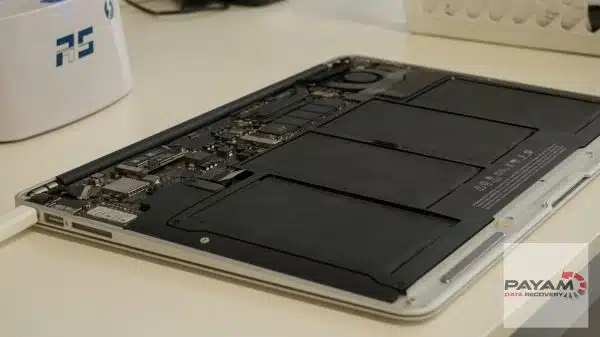
Diagnosing the power management IC failure
When the MacBook Pro was opened in the Melbourne lab, engineers began systematic power diagnostics. The power management IC controls voltage distribution across the entire logic board. When this chip fails, the MacBook cannot start even if all other components are functional.
In this case, corrosion caused by environmental moisture and dust buildup had damaged the power management IC. A nearby capacitor had also corroded, creating an electrical short. While the capacitor contributed to the issue, the primary fault preventing startup was the failed power management IC.
Power management IC repair process
Component-level repair was carried out under a microscope using precision micro-soldering tools. Engineers first removed the corroded capacitor, then extracted the failed power management IC from the logic board.
A replacement power management IC was soldered into place and the board was tested. When results were inconsistent, the IC was replaced a second time using a verified component. This methodical approach ensured the power distribution circuit was fully restored.
Once correct voltage levels were confirmed, the Apple logo appeared and the MacBook powered on normally.
Data recovery results
With the MacBook operational again, engineers accessed the internal storage and recovered all 135 GB of data. This included documents, desktop files, and a complete photo library containing years of personal memories.
Data was copied to an Apple-formatted external drive and verified. Because the client required Priority service due to upcoming travel, the entire recovery was completed within 24 hours. A file listing and video preview were provided before payment.
Symptoms of power management IC failure
Power management IC failure typically presents as a MacBook that is completely unresponsive. There is no fan noise, no startup chime, and no display activity. Unlike other logic board faults, there are no partial signs of power.
Repeated power-on attempts are not recommended. This type of failure requires component-level repair that standard computer repair shops cannot perform.
For general guidance on MacBook hardware issues, see
Apple MacBook Pro support documentation.
MacBook data recovery workflow
- Free assessment and quote
- Quote provided within 1 to 2 business days
- Work begins only after approval
- Priority service available for urgent cases
Frequently Asked Questions
My MacBook shows no sign of life at all. Is the data gone?
Usually not. This MacBook Pro would not power on, had no fan activity and no startup screen, and 135GB was recovered in full. A machine that cannot start is not the same as a machine that has lost its data.
What does the power management IC actually do?
It controls voltage distribution across the whole logic board. When it fails, the MacBook cannot start even if every other component is working perfectly.
What causes it to fail?
In this case corrosion, from environmental moisture and dust build up inside the machine. A nearby capacitor had corroded as well and was creating an electrical short, but the failed power management IC was the main reason it would not start.
Can the chip be replaced, or does the whole board need changing?
It can be replaced. The work is done under a microscope with precision micro soldering tools. The corroded capacitor was removed first, then the failed chip was extracted and replaced.
I have no iCloud backup. Does that change anything?
It raises the stakes rather than the difficulty. This customer had no backup, so years of photos and personal files depended entirely on the recovery.
What does MacBook data recovery cost, and when do I pay?
Every MacBook starts with a free assessment, then a written quote with Economy, Priority and Emergency service levels. For MacBook SSD recovery there is no attempt fee: you pay nothing up front and pay only if the recovery succeeds. Before that final payment we send you a complete file list and a video preview so you can check the quality first.
Related MacBook data recovery case studies
- MacBook liquid damage data recovery case study
- Dead MacBook Pro data recovery case study Australia
- MacBook Pro data recovery case study Australia
- iMac M1 A2439 case study
About Payam Data Recovery
Payam Data Recovery works with individuals, students, families, small and medium businesses, IT companies, and organisations that need their data recovered safely and professionally. Some customers come to us with a single damaged device containing personal memories, while others rely on us for complex technical recoveries that require specialist tools and experience.
We are based in Australia and have been recovering data since 1998. Our clients also include governments, law enforcement agencies, corporations, and public figures. Every job is handled with 100 percent confidentiality and privacy.
Request a MacBook data recovery assessment
Read more about our MacBook Data Recovery Service
Email: help@payam.com.au
Phone: 1300 444 800
International customers are always welcome. The easiest way to reach us from overseas is by email at help@payam.com.au, which works in every time zone.