

Published 25 April 2026. Updated 25 October 2026.
Case Study Summary
- Client: Samantha, school teacher from Sydney.
- Device: Unbranded USB flash drive, no markings, no available schematics.
- Problem: Drive was accidentally bent, snapping a pin where the USB connector attaches to the PCB. Years of teaching documents and photos sat on the drive.
- Solution: Manually traced the copper tracks on the PCB to find the damaged trace, ran a thin wire repair using precision microsoldering, secured it with UV-curing glue and hardened the joint with a UV light. Drive came back to life and was cloned sector-by-sector with PC-3000 Portable.
- Outcome: Over 1,200 files recovered, including Word documents, PDFs and photos. File list and video preview sent first, then the files returned on an external drive once paid.
- Service Page: USB Flash Drive Data Recovery
Bent USB Drive Data Recovery: Samantha’s Sydney Classroom Files Saved at the Rhodes, NSW Lab
Samantha is a school teacher from Sydney who accidentally bent her USB flash drive. The bend snapped a pin where the USB connector meets the PCB, and the drive stopped being recognised by any computer she plugged it into. The drive held years of teaching documents and photos, none of it backed up. To make the job harder, the USB was unbranded with no markings on the casing or the board, which meant no published schematics existed for the data recovery engineer to follow. She brought the drive to Payam Data Recovery’s lab in Rhodes, New South Wales. This bent USB drive data recovery case study walks through the manual copper-track repair, the microsoldering work that brought the drive back to life, and the 1,200-plus files that came off it inside 24 hours. If you’re looking for the matching service, see our USB flash drive data recovery service.
The Problem: A Bent USB, a Broken Pin, and No Schematics
A bent USB drive is one of the most common faults the lab sees. The bend itself is rarely the issue. The damage comes from where the USB connector meets the PCB. The connector pins are soldered to a small set of copper tracks on the board, and a sharp bend at the connector tears those tracks before it ever cracks the case. In Samantha’s drive, one of the connector pins had broken cleanly off its track. The drive had no electrical path to the controller chip on the other side of the board.
Where bent USB drive data recovery normally gets faster is when the drive has a known brand and model. The data recovery engineer pulls up the published board schematic, identifies the affected trace by reference number, and drops in the wire repair against a documented map. None of that helped here. The drive was unbranded. No markings on the casing, no markings on the PCB, no model number to look up. There was no schematic in any database the lab could pull from.
Without a published map, the only path forward is to read the board itself.
The Bent USB Drive Data Recovery Process
Step one of the bent USB drive data recovery was a manual trace of the copper tracks under magnification. The data recovery engineer worked outward from the broken pin, following each track on the board with continuity testing to identify where it terminated, what component it connected to, and whether the track itself was intact or torn. This is patience work. It’s also the only honest way to repair an undocumented PCB without guessing.
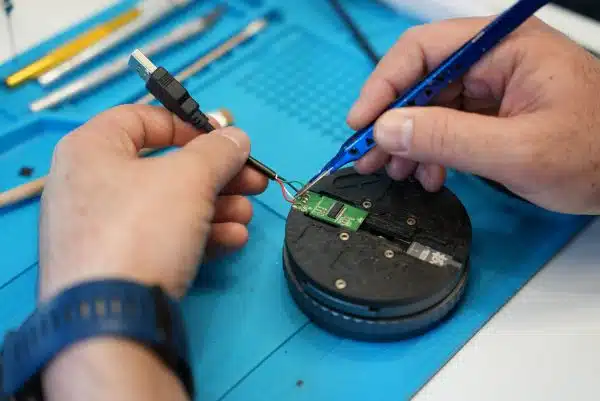
Once the damaged trace was identified, the bridge had to be physically built. A short length of fine wire was run from the broken pin’s pad across to the next intact section of the original copper track. Precision microsoldering placed both endpoints. The wire bridge then needed mechanical reinforcement so it wouldn’t break again the first time the drive was plugged in. UV-curing glue was applied along the bridge and a UV light cured the glue in seconds, locking the wire in place against the board.
The drive was tested. It came up. The host computer recognised the device and began enumerating its contents.
Step two of the bent USB drive data recovery was an immediate sector-by-sector clone. With a freshly repaired drive, the worst thing you can do is start reading user files directly. Repaired joints can re-fail. NAND that’s been off for a while can throw read errors. The right move is to image the entire device first onto stable media so all subsequent work happens on the copy, not the original. The clone ran on PC-3000 Portable, which is purpose-built for flash media imaging and handles read retries on weak sectors gracefully. Once the clone completed, the original drive was set aside and analysis began on the image.
Bent USB Drive Data Recovery Results
The bent USB drive data recovery delivered over 1,200 files. The mix matched what a school teacher’s working USB looks like: Word documents, PDFs, and photos, accumulated across years of classroom work. Samantha will receive an email with a complete file listing and a short video preview showing the recovered folder structure and a sample of the files opening cleanly. Once the recovery is paid, her recovered files come back to her on an external drive.
If a few files are needed urgently, we can upload a small amount straight away to a Google Drive folder we provide, or to a folder the customer shares with us.
Why Professional Bent USB Drive Data Recovery Matters
The temptation with a bent USB is to keep plugging it in and hoping it suddenly works. That’s the worst thing you can do. Each insertion attempt with a torn track puts mechanical stress on a connector that’s already structurally compromised, and partial contact at the wrong moment can short power across an unintended trace. A drive that started with one broken pin can end up with a fried controller within a few stubborn attempts.
The next temptation is to let a friend with a soldering iron have a go. Standard soldering irons are too hot and too coarse for USB PCB work. The pads on a USB drive’s board are tiny, the traces are thin enough that a moment’s heat will lift them off the substrate, and a successful repair on an unbranded board with no schematic requires the kind of magnification setup and continuity testing that lives in a recovery lab, not a kitchen workshop. Once a USB PCB has been damaged by an amateur repair attempt, the chip-off path becomes the only remaining option, and chip-off is more expensive and slower than a clean track repair.
Bent USB drive data recovery on an unbranded drive in particular is unforgiving. Without schematics there’s no reference for what the board should look like, so any change in the wrong direction is uncorrectable. Cloning with PC-3000 Portable immediately after the repair is what makes a lab process repeatable: even if the wire bridge fails later, the data is already off and on stable media.
For background on how USB flash storage works at the chip level, the Wikipedia article on USB flash drives covers controller and NAND architecture. For more on the printed circuit board techniques used in bent USB drive data recovery work, the Wikipedia article on printed circuit boards explains how copper tracks, vias, and pads are laid out and how trace damage propagates.
Why People Choose Payam Data Recovery
A snapped, bent or dead USB flash drive usually needs its broken connection restored at the circuit board, or its memory chip read directly, before the files can be recovered. That is the work we do every day.
- We are a specialist data recovery lab, not a computer repair shop. We have been recovering data since 1998, from over 300,000 devices.
- The best equipped data recovery lab in Australia: microscopes and microsoldering stations to restore broken connections on connectors and circuit boards, and professional tools such as the Ace Lab PC-3000 and Rusolut to read the memory chips directly when a connection cannot be restored.
- Over 2,000 IT companies and computer shops across Australia send us their customers’ complex cases, and data recovery labs and IT companies in more than 50 countries have sent us their difficult cases over the past ten years.
- Rated 4.9 from over 2,400 Google reviews.
- About 90% of our jobs are no fix, no fee. The hardest 10% carry an attempt fee.
- See your files before you pay. You tell us which files matter most. Before you pay for the recovery, we’ll send you a list of your recovered files so you can check them. If any of the files you listed are missing, tell us and we’ll search again.
- Pay by Visa, Mastercard, American Express, Apple Pay, Google Pay, Link or PayPal, split the cost with Afterpay, Zip, Klarna or PayPal Pay in 4, or pay by bank deposit (EFT).
- Everything is done in our own labs in Australia and never outsourced overseas. Call or visit us, and you can speak with the data recovery engineers who do the work.
We are not the cheapest. We are the best in Australia at this work. We know what to do, how to do it, and we will do our very best for you. Your best chance of getting your data back is with us.
Bent USB Drive Data Recovery Service Tiers
USB jobs are quoted after a free assessment, because the work depends on what’s broken: a torn trace and snapped pin (like Samantha’s drive), a snapped-in-half board, water damage, or a logical fault with no physical damage at all. Three bent USB drive data recovery turnaround tiers are available so customers can pick what fits their situation:
Economy. The right bent USB drive data recovery choice if you are working to a tight budget. Turnaround is 5 to 10 business days.
Priority. A faster bent USB drive data recovery path through the lab for jobs where waiting a week and a half isn’t realistic. Turnaround is 2 to 4 business days. Pricing is quoted on the free assessment.
Emergency. Round-the-clock bent USB drive data recovery work for cases where a deadline is looming or critical files are needed urgently. Most cases can be done on the same day. Samantha’s bent USB job closed in roughly 24 hours. Pricing is quoted on the free assessment.
For most basic faults there is no charge if unsuccessful: nothing is paid upfront, and you only pay once the data is recovered and you have checked the file list. Chip-off and monolith work carries a non-refundable attempt fee that forms part of the total quoted price. If an attempt fee applies to your job, it is stated clearly in the free quote before you approve anything.
Because every step happens in house in Australia, there are no overseas handoffs, no shipping queues between subcontractors, and no waiting on a third-party lab to schedule your job.
How Our Process Works for International Customers
Payam is an Australian company, but a steady share of our caseload comes from outside Australia. Managed IT service providers, internal IT managers, and other data recovery companies around the world send us bent USB drive data recovery cases their tools or workflow can’t cover. The process is straightforward:
- Complete the free quote form. Use our USB drive data recovery quote page and describe the device, the failure, and any urgency. We come back with an indicative price range so you know whether the job fits your budget before any drives move.
- If the quote works, submit the job. Once you are happy with the indicative pricing, fill out our submit a new job form. You receive a job number and detailed delivery instructions for our Australian lab.
- Ship with a trusted international courier. Use FedEx, DHL, or UPS. On the customs declaration, the items must be declared as faulty for repair with a very low declared value. The drives are not being sold or bought, they are faulty hardware coming in for diagnostic and recovery work, so a low declared value is accurate and avoids unjustified customs duties or import taxes on a transaction that isn’t actually a sale.
- Free assessment, then a fixed quote. Once your USB drive arrives at the lab in Rhodes, NSW, the assessment runs and a fixed written quote follows.
- Recovery, then delivery. If you approve the quote, the bent USB drive data recovery begins. Your recovered files come back on an external drive, and we can return ship anywhere in the world.
Every step from the moment the drive lands at our lab to the moment the data leaves it happens in house, by our own Australian team, on our own equipment. Nothing is outsourced and nothing is shipped to another lab during the recovery, which is why we can hold the same Emergency turnarounds for international clients as we do for Australian ones. The easiest way for an international customer to reach us is by email at help@payam.com.au, which works in every time zone.
Frequently Asked Questions About Bent USB Drive Data Recovery
My USB drive got bent and isn’t recognised any more. Can the data still come back?
Usually, yes. Samantha’s USB had a snapped pin and a torn copper track on the PCB and was completely unrecognised by Windows. After a manual track trace, a microsoldered wire bridge and a UV-cured anchor, the drive came back online and 1,200-plus files were copied off. Bent USB drive data recovery success comes down to whether the controller chip and NAND chip on the board are still intact. If the bend only damaged the connector and traces (which it usually does), the data is recoverable.
What makes recovery harder when the USB is unbranded?
Branded drives often have published board schematics that show the layout of every trace and pad, which makes locating the damage and planning the repair much faster. Unbranded drives have no published schematic, so the data recovery engineer has to manually trace each copper track on the PCB under magnification and use continuity testing to identify the broken trace. The repair takes longer than a comparable branded drive job, but the recovery itself is no less reliable.
What is microsoldering, and why does it matter for USB recovery?
Microsoldering is precision soldering performed under a stereo microscope at scales where standard solder irons would destroy the workpiece. USB PCB pads are tiny, traces are thin, and a moment’s excess heat lifts them off the substrate permanently. Microsoldering allows the data recovery engineer to place a fresh wire bridge across a broken trace cleanly, without damaging the surrounding board. UV-curing glue then anchors the wire mechanically so the bridge survives the next insertion of the drive into a USB port.
How long does bent USB drive data recovery take?
Samantha’s drive closed in roughly 24 hours, which sits at the fast end of the range. Standard turnarounds run 5 to 10 business days for Economy and 2 to 4 business days for Priority. Cases with simple connector damage close fastest. Cases requiring chip-off or monolith work take longer because the chip extraction and reading process adds steps that connector repair doesn’t need.
I am working to a tight budget. Can you still help with a bent USB recovery?
Yes. The Economy tier is built for exactly that situation. The price depends on repair complexity and is confirmed in writing after a free assessment. Current prices are on our USB flash drive data recovery page. For most basic faults there is no charge if unsuccessful.
How do you deliver the recovered files?
Your recovered files come back on a new USB or external drive. If a few files are urgent, we’ll upload a small amount straight away to a Google Drive folder we provide, or to a folder you share with us. In Australia we ship via Australia Post Express, and internationally via FedEx, DHL or UPS.
I tried plugging it in many times before bringing it in. Did I make things worse?
Possibly, but rarely fatally. Each insertion of a bent USB with a torn trace risks shorting power across an unintended connection or further damaging the connector pads. The drive is usually still recoverable, but the repair becomes more involved if the controller chip itself has taken damage from a short. The safest move when a USB drive bends is to stop using it immediately and bring it in for assessment.
I’m not based in Australia. How does shipping and customs work?
Start with our free quote form so you can see whether the indicative pricing fits your budget. If it does, fill out the submit-a-job form to receive a job number and delivery instructions, then ship the USB drive in via a trusted international courier (FedEx, DHL, or UPS work well). On the customs declaration, the item should be declared as faulty hardware for repair with a very low declared value. The drive isn’t being sold or bought, it’s faulty for repair, so a low value is accurate and avoids unjustified customs duties or import taxes. The recovered files then come back to you on an external drive.
What should I do right now if I’ve just bent my USB drive?
Stop using it. Don’t keep trying it in different ports hoping one will work. Don’t try to bend it back into shape. Don’t let a friend with a soldering iron have a go at it. Pack it in an anti-static bag or a small padded envelope and either ship it to a Payam lab or drop it off at one of our locations. The first hour after a bend has more impact on recoverability than anything that happens later.
About Payam Data Recovery
Payam Data Recovery is an Australian company, in business since 1998, with more than 300,000 devices recovered to date including thousands of bent USB drive data recovery jobs. Every recovery happens in our own labs in Sydney, Rhodes NSW (where Samantha’s case was handled), Melbourne and Brisbane, with secure drop-off offices in Adelaide and Perth, which send your device to our lab in Rhodes, NSW at no cost. Our equipment includes Ace Lab PC-3000 and PC-3000 Portable, Rusolut Visual NAND Reconstructor, professional chip readers, and microsoldering stations with UV curing for delicate USB and flash media work. Nothing is ever outsourced. The team that opens the assessment is the same team that finishes the recovery, start to finish, which is what makes Emergency turnarounds possible. We regularly take international cases referred by managed IT service providers, IT managers, and other data recovery companies from around the world. Visit our homepage or read more about our USB flash drive data recovery service.
Request a Free Bent USB Drive Data Recovery Assessment
Bent USB, broken connector, snapped USB drive, water-damaged USB, or a USB that just isn’t recognised any more? Our bent USB drive data recovery team can help.
On a tight budget? Ask about our Economy bent USB drive data recovery service, with the full quote confirmed after a free assessment.
Need it back fast? Priority and Emergency bent USB drive data recovery tiers are built for urgent cases. Because every step is done in house by our own Australian team, there is no waiting on a third-party lab and no overseas handoffs slowing things down. Emergency jobs run 24/7 for the fastest turnaround humanly possible.
We cover: All USB brands including Kingston, SanDisk, Verbatim, Lexar, PNY, Samsung, and unbranded USB drives. All damage types including bent connector, snapped board, water damage, monolith chip recovery and chip-off. All file types including Word, PDF, Excel, photos, video, audio and CAD.
Australian bent USB drive data recovery, international clients welcome. Managed IT service providers, IT managers, and other data recovery companies from around the world send us cases regularly. Start with a free quote, then ship in via FedEx, DHL, or UPS once the indicative price works for you. Your recovered files come back to you on an external drive.
USB Flash Drive Recovery Service
Get a Free Quote
Or submit a new job online once you have an indicative quote.
Phone: 1300 444 800 | Email: help@payam.com.au
Related USB and Flash Media Recovery Case Studies
- Dead SanDisk USB stick with a short circuit, photos recovered
- SanDisk USB flash drive data recovery case study
- USB connector repair Perth case study
- CFexpress memory card formatted wedding photos recovery
- AI assisted SD card recovery
- Emergency USB flash drive data recovery case study
Video Transcript (click to expand)
Hi, it’s Mike, and today I’m visiting Payam Data Recovery’s lab in Rhodes, New South Wales to see how their data recovery engineers work on a broken USB flash drive, a very common problem. I’m watching them work on a case for Samantha, a school teacher from Sydney who accidentally bent her USB flash drive. It had a broken pin where the connector attaches to the PCB. The drive contained years of teaching documents and photos, and it was an unbranded USB drive with no markings, so there were no schematics available.
Without schematics, the data recovery engineer manually traced the copper tracks on the PCB to find the damage. Using precision microsoldering, he ran a thin wire to repair the damaged copper track, secured it with UV-curing glue, and hardened it with UV light. The USB flash drive was functional again. The data recovery engineer immediately cloned it using PC-3000 Portable, making a sector-by-sector copy.
Success. Over 1,200 files were saved: Word documents, PDFs, and photos. Samantha will receive an email with a complete file listing and video preview showing her recovered files. Once paid, she’ll get her files back on an external drive. This shows what sets Payam Data Recovery apart. If you’ve got a bent or broken USB flash drive, contact Payam Data Recovery to get your data back. Thanks for watching.


