

QNAP NAS RAID 5 Data Recovery Case Study Summary
- Client: Andrew, Mascot, NSW, Australia
- Device: QNAP NAS, 4 hard drives, RAID 5 configuration
- Problem: Seagate’s own data recovery lab in the USA declared recovery impossible. One drive tampered with (previously opened), one drive dead, one drive with thousands of bad sectors
- Diagnosis: Tampered drive completely dead (not spinning), second drive had thousands of bad sectors, two drives healthy. RAID initially showed empty Linux partition requiring deep scan
- Solution: Cloned three working drives using Atola Insight Forensic, performed deep scan over 3 days to locate files beneath empty Linux partition
- Outcome: 10 years of family photos and documents fully recovered in 2 weeks
- Service: RAID and NAS Data Recovery
When Seagate’s own data recovery lab in the USA told Andrew from Mascot, New South Wales, that recovering data from his failed QNAP NAS was impossible, he turned to Payam Data Recovery in Australia. This QNAP NAS RAID 5 data recovery case study documents how Payam succeeded where Seagate failed, recovering 10 years of family photos and documents from a four-drive RAID 5 array with one tampered drive, one drive with thousands of bad sectors, and a hidden file system that required a 3-day deep scan to locate.
This QNAP NAS RAID 5 data recovery case study is a powerful example of why the expertise behind the recovery matters as much as the tools. With a RAID 5 configuration, data is distributed across all drives with parity, meaning recovery may still be possible even when one drive has completely failed. But it takes experience, professional tools, and a problem-solving approach to make it work. Based in Australia, Payam Data Recovery also regularly handles complex RAID and NAS recovery cases from the USA, New Zealand, UK, and worldwide, often recovering data that other companies, including manufacturers, have declared impossible.
The Problem: QNAP NAS Declared Impossible by Seagate
Andrew’s QNAP NAS contained four hard drives in a RAID 5 configuration, holding approximately 10 years of family photos and documents. After the NAS failed, he sent the drives to Seagate’s own data recovery lab in the USA. Seagate said it was impossible.
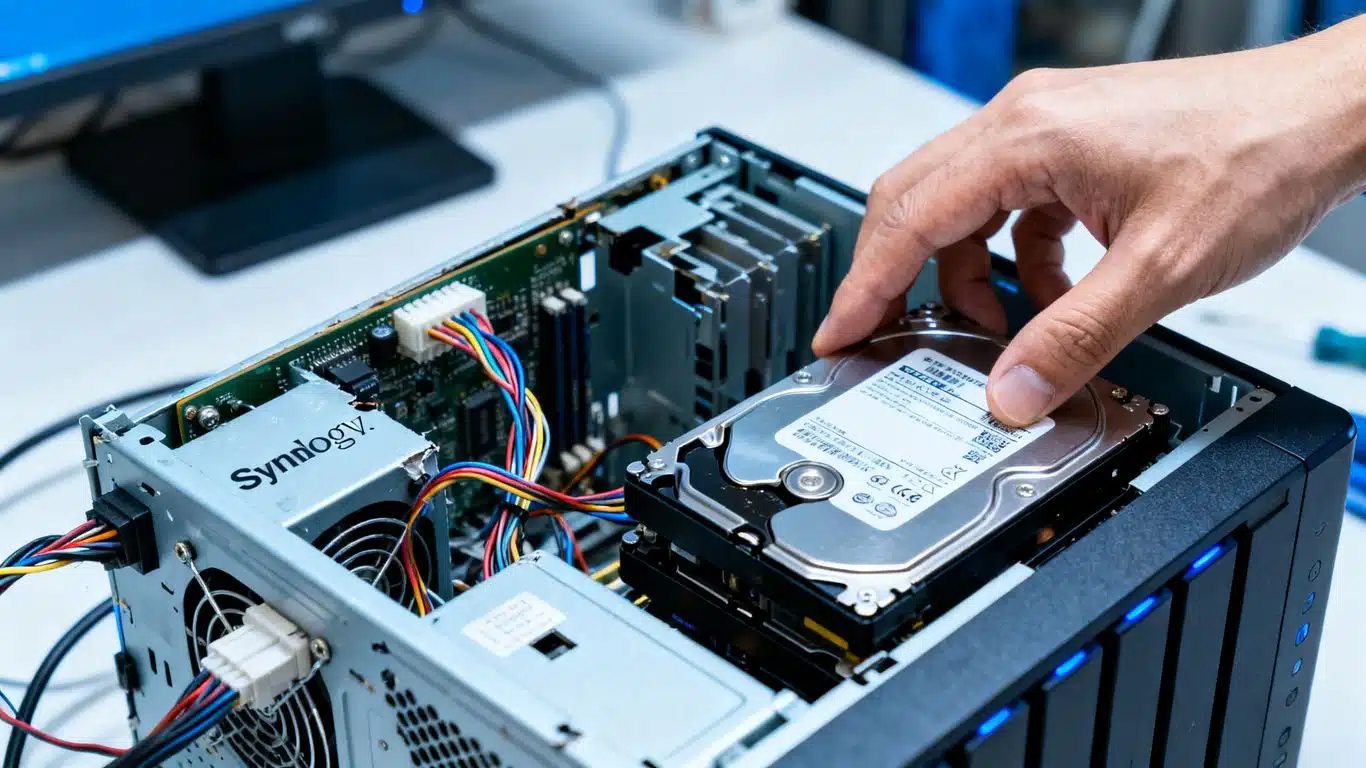
When the drives arrived at Payam Data Recovery in Rhodes, NSW, senior technician Paolo noticed something immediately. One of the drives had a hole in the label where the head screw sits underneath, clear evidence that someone had been inside the drive. This tampered drive had been previously opened, likely by Seagate during their failed recovery attempt.
QNAP NAS RAID 5 Data Recovery Case Study: Diagnosis
The data recovery engineer tested all four drives individually using the Atola Insight Forensic tool. The results revealed:
- Drive 1 (tampered): Completely dead, not even spinning
- Drive 2: Thousands of bad sectors
- Drive 3: Healthy
- Drive 4: Healthy
The critical insight in this QNAP NAS RAID 5 data recovery case study was understanding that RAID 5 can tolerate one failed drive. With one drive dead and one drive degraded with bad sectors, the data recovery engineer determined that cloning the three remaining drives (including the degraded one) could still yield a successful recovery. The dead tampered drive that Seagate had opened was never touched, saving Andrew time and money.
The QNAP NAS RAID 5 Data Recovery Case Study Process
The data recovery engineer cloned all three working drives and let them run overnight. Once the cloning was complete, the RAID configuration was detected automatically. However, the initial result was unexpected: the array showed an empty Linux partition with no files visible.
The data recovery engineer called Andrew to ask whether anyone had reformatted the NAS. Nobody had. This meant the file system had become corrupted or the partition table had been damaged, and a deep scan was needed to locate the data beneath the empty partition.
After 3 days of deep scanning, all the files and folders were found. Everything was saved to a new drive, tested for damage, and Andrew received a complete file list with a video preview of the recovered data. The entire recovery was completed in 2 weeks from start to finish.
This QNAP NAS RAID 5 data recovery case study demonstrates a critical principle: when a RAID array shows an empty partition, the data may still be intact underneath. A deep scan at the raw level can locate file structures that standard tools cannot see.
QNAP NAS RAID 5 Data Recovery Case Study Results
The recovery was a complete success. Payam Data Recovery recovered all of Andrew’s data, including:
- 10 years of family photos
- 10 years of family documents
- Complete folder structure preserved
All recovered data was saved to a new drive, tested for damage to confirm integrity, and Andrew received a complete file list with a video preview. The dead tampered drive that Seagate had previously opened was never needed for the recovery, saving additional cost and complexity.
Seagate’s own data recovery lab in the USA said this case was impossible. Payam Data Recovery completed it in 2 weeks. As the video states: sometimes it’s the person working on your case that makes all the difference.
Why Professional QNAP NAS RAID 5 Data Recovery Matters
This QNAP NAS RAID 5 data recovery case study illustrates why RAID recovery is not something a local IT professional can typically handle. It requires experience, professional tools, and a problem-solving approach that goes beyond standard IT support.
Key challenges in this QNAP NAS RAID 5 data recovery case study included:
- Identifying that one drive had been tampered with and choosing not to use it
- Cloning a degraded drive with thousands of bad sectors without causing further damage
- Recognising that an empty Linux partition did not mean the data was gone
- Performing a 3-day deep scan to locate files beneath the corrupted file system
- Testing recovered files for integrity before delivery
Professional RAID and NAS data recovery at Payam Data Recovery involves individual drive testing with Atola Insight Forensic tools, hardware-based cloning, RAID array reconstruction, deep scanning for hidden file systems, and thorough data integrity verification. Over 2,000 IT companies and computer repair businesses across Australia trust Payam with their most difficult cases.
RAID and NAS Data Recovery Pricing and Assessment
If you are facing a situation similar to this QNAP NAS RAID 5 data recovery case study, RAID and NAS data recovery at Payam Data Recovery typically ranges from $800 to $5,000, with complex multi-drive cases up to $10,000. Pricing depends on the number of drives, RAID configuration, and fault complexity.
- Free Assessment: 1 to 2 days from delivery, no obligation
- Urgent Assessment: $500, completed within 2 to 3 hours of delivery
- Attempt Fee: Approximately $500 upfront for most RAID jobs (included in total price, not added on top)
- Success Rate: 99% for most RAID recoveries
- Turnaround: 1 to 2 days for simple cases, longer for large datasets due to transfer time
All prices include GST. Free return postage is included. If recovery is unsuccessful, the attempt fee is the only cost.
Payam Data Recovery serves customers across Australia with laboratories in Sydney, Melbourne, and Brisbane, plus secure drop-off points in Perth and Adelaide with free shipping both ways. We also welcome international customers from the USA, New Zealand, UK, and worldwide. If another data recovery company, including the manufacturer’s own lab, has told you recovery is impossible, contact us. Nobody will try harder or invest more expertise into your case.
NAS brands we recover data from include: QNAP, Synology, Western Digital (My Cloud), Buffalo, Netgear (ReadyNAS), Drobo, ASUSTOR, TerraMaster, Seagate, LaCie, Thecus, D-Link, Promise Technology, Infortrend, OWC, UniFi (UNAS), Ugreen (NASync), Dell (PowerVault), HPE (ProLiant, StoreEasy), and Lenovo (ThinkSystem). We handle SATA, SAS, and SCSI hard drives as well as SSD RAID arrays.
Frequently Asked Questions: QNAP NAS RAID 5 Recovery
Can data be recovered from a QNAP NAS after Seagate said it was impossible?
Yes. In this QNAP NAS RAID 5 data recovery case study, Seagate’s own data recovery lab in the USA declared the case impossible. Payam Data Recovery recovered all 10 years of family photos and documents in 2 weeks. The expertise and problem-solving approach of the team made the difference.
What is RAID 5 and why can it still be recovered with a dead drive?
RAID 5 distributes data and parity information across all drives in the array. This means one drive can fail completely and the data can still be reconstructed from the remaining drives. In this case study, one drive was dead and another had thousands of bad sectors, but the three remaining drives provided enough data for a full recovery.
What does it mean when a hard drive has been tampered with?
A tampered drive shows evidence of being previously opened, such as a hole in the label where the head screw sits underneath. This typically means someone attempted a repair or recovery without a proper cleanroom environment. In this case, Seagate had opened the drive during their failed attempt. Payam chose not to use this drive, completing the recovery from the other three drives instead.
Why did the RAID show an empty partition when the data was still there?
In this QNAP NAS RAID 5 data recovery case study, the RAID array showed an empty Linux partition because the file system or partition table had become corrupted. The actual data was still intact on the drives underneath the damaged file system. A 3-day deep scan at the raw level located all the files and folders. This is a common scenario in NAS failures.
How much does QNAP NAS RAID recovery cost in Australia?
RAID and NAS data recovery at Payam Data Recovery typically ranges from $800 to $5,000, with complex multi-drive cases up to $10,000. A free assessment (1 to 2 days) or urgent assessment ($500, 2 to 3 hours) determines the exact quote. An attempt fee of approximately $500 is included in the total price, not added on top. If recovery is unsuccessful, the attempt fee is the only cost.
How long does QNAP NAS RAID 5 recovery take?
In this QNAP NAS RAID 5 data recovery case study, the entire recovery was completed in 2 weeks from start to finish, including 3 days of deep scanning. Turnaround varies depending on the number of drives, the amount of data, and the complexity of the fault. Simple RAID cases can be completed in 1 to 2 days.
Should I try to rebuild my RAID array myself before sending it for recovery?
No. Never attempt to rebuild, reinitialise, or reformat a failed RAID array. This can overwrite data and make recovery significantly more difficult or impossible. Send all drives to a professional data recovery company in their current state. Do not remove drives from the NAS or change their order.
What NAS brands does Payam Data Recovery support?
Payam Data Recovery recovers data from all NAS brands including QNAP, Synology, Western Digital, Buffalo, Netgear, Drobo, ASUSTOR, TerraMaster, Seagate, LaCie, and many more. We handle all RAID configurations including RAID 0, RAID 1, RAID 5, RAID 6, RAID 10, and custom configurations.
What tools does Payam use for RAID recovery?
Payam Data Recovery uses Atola Insight Forensic tools for individual drive testing and cloning, professional RAID reconstruction software for array rebuilding, and specialised deep scanning tools for locating data beneath corrupted file systems. All work is performed in Australia and never outsourced overseas.
Does Payam Data Recovery accept NAS cases from outside Australia?
Yes. While based in Australia, Payam Data Recovery regularly handles complex RAID and NAS recovery cases from the USA, New Zealand, UK, and worldwide. We often recover data from cases that other companies, including manufacturers like Seagate, have declared impossible. Contact us at help@payam.com.au or call 1300 444 800.
About Payam Data Recovery
Payam Data Recovery is Australia’s longest-established data recovery company, founded in 1998 with over 150,000 successful recoveries completed. The company is trusted by over 2,000 IT professionals and computer repair businesses across Australia who send their most difficult cases.
With full-service laboratories in Sydney (including the head office and main specialised lab in Rhodes, NSW), Melbourne, and Brisbane, plus secure drop-off points in Perth and Adelaide with free shipping both ways, Payam Data Recovery serves customers across Australia and internationally. All recovery work is performed in Australia and is never outsourced overseas.
For RAID and NAS recoveries, the team uses Atola Insight Forensic tools, professional RAID reconstruction software, hardware-based cloning systems, and deep scanning tools. This QNAP NAS RAID 5 data recovery case study is one example of the many complex RAID recoveries completed every year, including cases that other companies and manufacturers have given up on.
Has Another Company Said Your RAID Recovery Is Impossible? We Can Help.
NAS failed? RAID array inaccessible? Another data recovery company given up? Payam Data Recovery regularly recovers data from cases that other companies, including manufacturers, have declared impossible.
RAID and NAS data recovery pricing: Typically $800 to $5,000, complex cases up to $10,000. Free assessment available. Attempt fee approximately $500 (included in total price). 99% success rate for most RAID recoveries.
All NAS brands supported: QNAP, Synology, Western Digital, Buffalo, Netgear, Drobo, ASUSTOR, TerraMaster, and many more. All RAID configurations including RAID 0, 1, 5, 6, 10.
Based in Australia. International customers welcome. We regularly handle complex RAID cases from the USA, New Zealand, UK, and worldwide. Over 2,000 IT companies across Australia trust us with their toughest cases. If someone has told you your case is impossible, give us a call. Sometimes it’s the person working on your case that makes all the difference.
Submit your NAS for recovery | Phone: 1300 444 800 | Email: help@payam.com.au
Related RAID and NAS Data Recovery Case Studies
- DVR Hard Drive Data Recovery Case Study
- 16 Drive RAID Recovery Case Study
- Seagate Personal Cloud NAS Recovery Case Study
Video Transcript: QNAP NAS RAID 5 Data Recovery Case Study
Hey, it’s Mike visiting Payam Data Recovery and meeting with Payam Toloo to see how they recovered data from failed hard drives from a NAS unit for Andrew from Mascot, New South Wales.
This case came in after Seagate’s own data recovery lab in the USA said it was impossible. Four drives from a QNAP NAS RAID 5 configuration, about 10 years of family photos and documents.
When Payam opened the box, he noticed something straight away. See this drive here? There’s a hole in the label where the head screw sits underneath. Someone’s been inside this one.
He tested all four drives using the Atola Insight Forensic tool. The tampered drive, completely dead, not even spinning. But here’s the thing with RAID 5. You might not need every drive.
The second drive had thousands of bad sectors. The other two were healthy.
So Payam cloned the three working drives and let them run overnight. The RAID was detected automatically, but it showed an empty Linux partition. No files.
So Payam called the customer to ask some questions. Nobody had reformatted it. This meant a deep scan was needed.
After 3 days, there they were, all the files and folders. Everything was saved to a new drive, tested for damage, and the customer received a complete file list with a video preview.
The dead drive that Seagate opened, never touched. Didn’t need to. That saved the customer time and money.
This is why RAID recovery isn’t something your local IT guy can handle. It takes experience, professional tools, and a problem-solving approach. Seagate couldn’t do it. Payam did. 2 weeks start to finish. And this customer got back a decade of memories.
If someone’s told you your case is impossible, give Payam Data Recovery a call. Sometimes it’s the person working on your case that makes all the difference.